
















A proposal for heavy social studies curriculum changes is currently in discussion with the Texas State Board of Education. Nine esteemed reviewers were chosen to critique the new curriculum. The overall message for this change would be to “create an American and Texas identity” as defined by SBOE-appointed reviewer Donald Frazier, the director of the Texas Center at Schreiner University in Kerrville. Some changes could include topic name, course rigor and the amount of work being included into one year.
Additionally, Kimberly Gonzalez, a 5th grade Reading and Language Arts teacher, believes that multiple perspectives need to be considered in order to get a more accurate history being taught. After analyzing the new message of these changes, she believes some things need to be considered.
“Students should learn about both the achievements and struggles within history so they can develop critical thinking skills and a more complete understanding of the world. Education should encourage students to analyze information, ask questions and think independently,” Gonzalez said.
One major change would be the amount of topics included in all levels of primary school. With an emphasis on Texas history from an early age, some teachers worry about the lack of critical thinking skills students have that young.
“For some students, the increased rigor could help them become stronger critical thinkers,” Gonzalez said. “However, younger students may struggle with certain topics if the content is not developmentally appropriate or organized clearly.”
On a bigger note, the board in charge of making these decisions are known to not have classroom experience. One Houston-area educator, who asked to remain anonymous out of concern for retaliation, said the board needs that experience.
“When it comes to being an educator in the state of Texas, the governing powers of the state have taken into consideration very little what happens in a modern classroom as well as what needs to be taught to the youth of Texas,” the teacher said.
To accept these changes, teachers have a few conditions for the expectation of succeeding. Gonzalez believes in a clear outline of these things.
“I would recommend focusing more on depth instead of quantity by limiting the number of topics covered and allowing students to explore important concepts more thoroughly … [as well as] in a clear chronological order that multiple perspectives are included,” Gonzalez said.
Down the line, high school teachers are concerned that if the curriculum is not followed in a clear and concise path, knowledge gaps could be created. Journalism teacher Andrea Negri believes that social studies heavily overlaps with journalism. She believes in the importance of U.S. History for students to fully understand students’ rights as journalists. Already, she has to reteach these topics. If some of her students don’t grasp basic history knowledge, the content could be challenging.
“I really worry about the gap. The knowledge gaps my students are going to come in with. Maybe, I’m going to have to do even more instruction,” Negri said.
In contradiction to elementary school teachers, Alicia Montes, a U.S. History dual credit teacher for College Academy, sees the benefit of the increased rigor at a younger age. While she acknowledges how hard it could be for teachers to change, she believes the benefit for the students is greater.
“I think that overall, what it’s going to do is it’s going to give younger children a chance to explore and understand important topics earlier, and history and education builds and spirals on each other,” Montes said. “I think by introducing them to some of these concepts at a younger age, by the time they get to me. We’re going to be able to dive into deeper meaning stuff because they’ll know.”
In addition to major curriculum changes being changed, smaller details may have a bigger impact. Several cultural changes being made include the omitting of the Japanese-American Internment camps (the internment of Japanese-Americans into camps because of fear of spies during World War II).
“That was one of those things that I learned about in school that really made me want to dig deeper into why that happened, and how it affects people and… acknowledge as well that we did,” Negri said.
During the April SBOE meeting, some members raised concerns that one reviewer was motivated to suggest changes based on a grant from a conservative group.
“The most important thing for teachers to do when teaching history and teaching government is they can’t do so as a Republican and they can’t do so as a Democrat,” Montes said. “They have to do it as a teacher and only as a teacher… You’re not doing the kids justice, you’re not doing the content justice, and really you’re not doing your job.”
Additionally, an anonymous teacher believes that is the main discourse in today’s society.
“If you cannot sit down with a friend, neighbor or colleague, and disagree with their political, religious or educational viewpoints and remain friends: the problem is YOU! How can we ever hope to change for the better if we cannot even listen to those who [we] disagree with to learn a new viewpoint?” the anonymous teacher said.
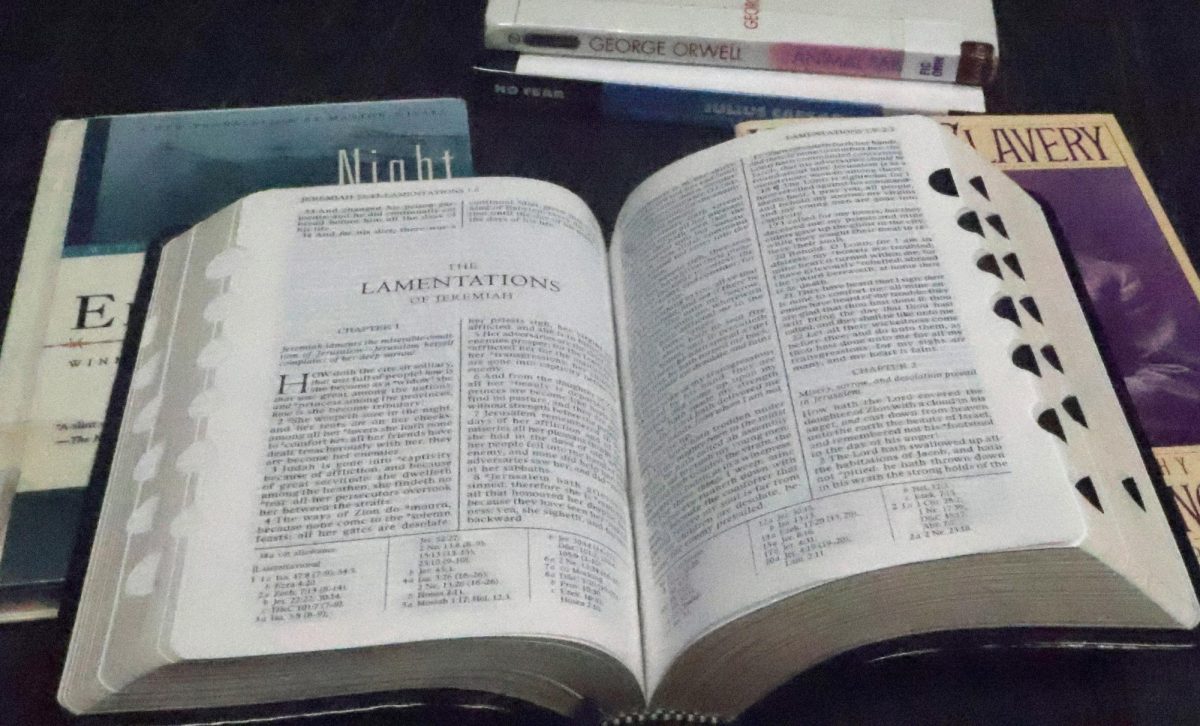
Another major change that has caused some discourse is the inclusion of some biblical stories becoming historical events in the curriculum. Stories like the Tower of Babel (lesson of pride and destruction of Jerusalem to Babylonians) , the Book of Lamentations 3 (gives Babylonian siege details and shows the weight of sin) , Genesis 1:1-9 (shows details of the Tower of Babel) , Ecclesiastes 3 (historically it talks about King Solomon while also showing the limitations of time) and the Book of Job 1-42 (addresses why a person suffers and shows the historical reference the land of Uz) .
Critics like Dr. Kate Rogers, who was one of the content advisers, expressed concern of separation of church and state.
“It is my opinion that we are blurring the separation between Church and State intended by the country’s founders and violating the First Amendment of the Constitution which prohibits the formation of a national religion and the posting of religious documents in public spaces,” Rogers said.
One teacher believes these changes are OK, especially considering the founding of this country. Montes has no concerns of implementing these teachings because they give historical reference as long as other religions are also considered for a whole look on history.
“It looks like to me they did a pretty good job making it kind of well-rounded. But historically speaking, America was founded on the religion of Christianity. Those two were intertwined. You can’t take that out,” Montes said.


Marielle • May 18, 2026 at 1:16 PM
Wow! So talented!