







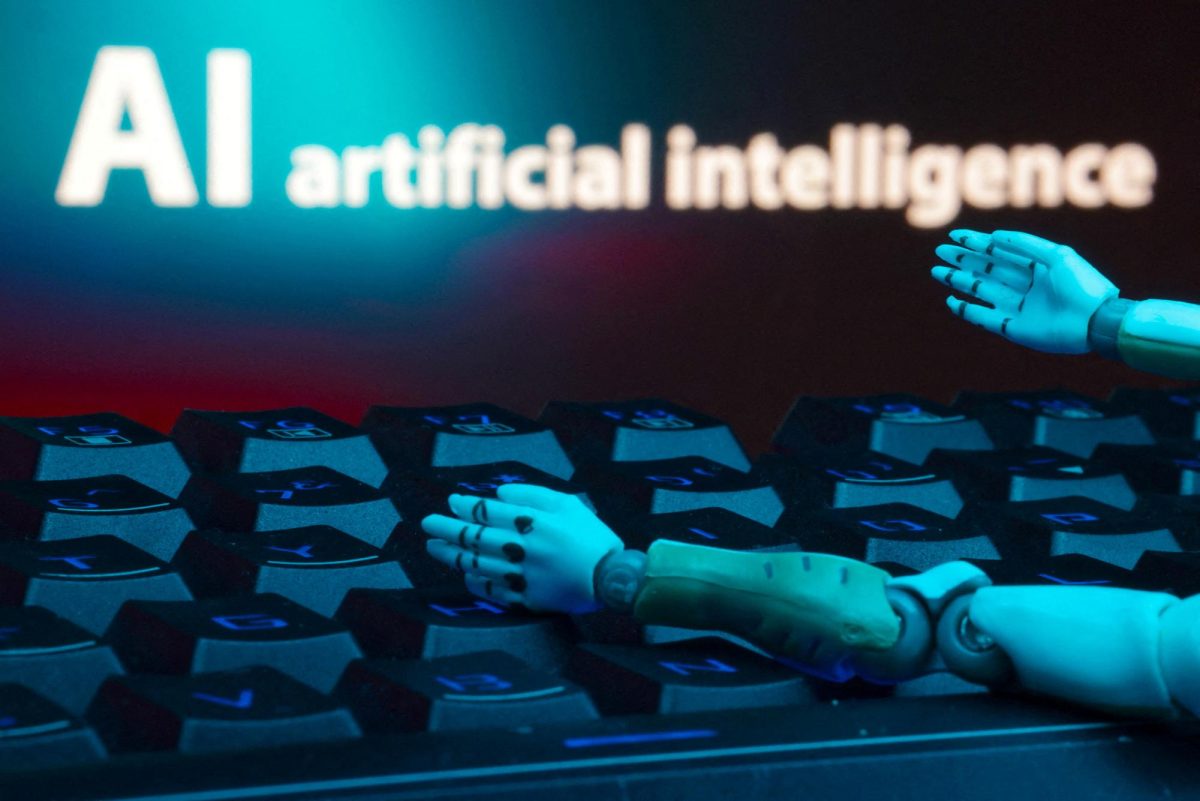







With each day that passes, AI gets smarter at a faster rate than we can keep up with. Its intelligence and easy accessibility naturally poses itself as a convenient source for many to utilize. This leads to controversy across the nation about the ethics of AI, and of course, many strong stances about its purpose have spread to Cy Woods. While there are various viewpoints on AI, a popular belief is in regards to using it as a valuable tool for assisting school work, while others say it makes people become less self-reliant, shedding away the intelligence of the current and future generations.
Throughout the past three years, AI has become prevalent in schools with the emergence of applications such as ChatGPT, Google Gemini and many more. Senior Tega Ekokotu has experienced the rapid growth of AI’s popularity throughout high school.
“AI can be very productive and help people learn in better ways than teachers. However, I do believe that it has also affected some people’s learning ability and some people’s ability to do things on their own,” Ekokotu said.
There are many concerns about how AI will affect the current and future generations in adulthood, with common worries that relying on AI will cause adults in the future to struggle.
“It depends on person to person, because some people use AI responsibly and they use it in a way to help them. But the ones that use it in order to cheat and never learn from it in any way, I think they might struggle,” Ekokotu said.
As someone who has taught high schoolers for years, English teacher Sol Ah Lim believes that students, and even adults, are becoming too dependent on using AI to the point where it is a necessity for fueling basic wonders, or even assisting with mental advice.
“I think it’s going to be almost like a partnership. I already see so many of my own friends, people my age and younger, relying on AI for even recipes to cook or to get thoughts and ideas on certain topics, and some people even use it as a therapy method,” Lim said.
Additionally, since Lim is an English teacher, she has to deal with students frequently using AI to complete schoolwork, having the hardest time when it comes to essays and writing assignments.
“As an English teacher, that’s something I really struggle with, because it gets to a point where if I have to have any written assignments done, I have to do it in class,” Lim said.
While it is frustrating for students to have to finish all of their writing in class, the risks of using AI are far too high for English teachers to allow kids to take their work home. Despite this, AI is still accessible with the school Chromebooks, leaving teachers with the responsibility of finding more solutions.
“The way I’ve gone about it is in my AP classes, most of the writing will always be in class in a timed write or in a lockdown browser,” Lim said.
Ekokotu offers a completely different stance on using AI in the classroom, believing that there is no choice but to integrate AI into school as we will only fall behind while the rest of the world advances.
“Banning AI in school is just ineffective because we will have to move with the times, and AI is becoming a part of our everyday society,” Ekokotu said. “We can’t just trap school in a time period when everything around us is advancing.”
For students, it can be challenging wrapping your thoughts and ideas together when it comes to creative writing, so it is common that they resort to using AI to form their thoughts. Lim stands by the fact that there are no benefits to using AI to help students gain inspiration or elaborate on ideas that they may have had trouble getting across.
“Students always say: I used it to brainstorm; I used it for inspiration, but I didn’t copy. They may have paraphrased, but that original thought did not come from them,” Lim said.
Conversely, Ekokotu thinks that AI can be helpful in this sense and does not take away from the learning potential when using it to expand ideas.
“If you type into AI all your thoughts, like what you want it to say, technically that is your own words. You’re just having it summarize it for you,” Ekokotu said. “Some people are bad at expressing themselves through words and I feel like AI is helping people reach the voice that they didn’t know they had.”
While the ethical uses of AI are one of the more discussed topics, Lim offers her concerns regarding the environmental impacts that AI has caused.
“I think if people knew the consequences environmentally, that maybe they’d be a little bit more mindful of what they use that platform for,” Lim said. “But they don’t realize that the engines that run AI take up so much electricity, and in order to cool those engines, there’s so much water involved to cool them.”